Plinko Casino Australia: Games, Formats and Safety
 Available in US
Compare slot and ball-drop formats, review verification and licensing considerations, and understand how crypto and provably fair Plinko sites work.
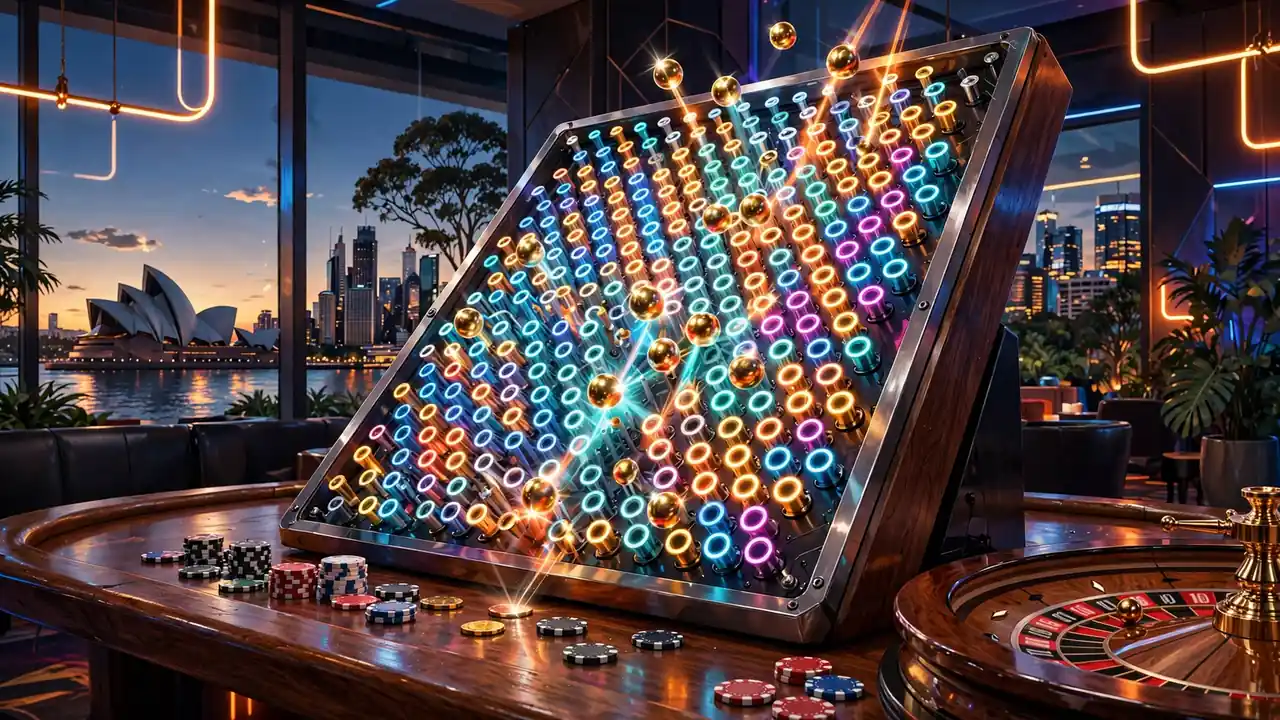
Table of Contents
- How Plinko-Style Slots Work
- Plinko Online Casinos: Formats, Providers, and Verification
- Playing Plinko for Real Money in Australia
- Casino Game Plinko and Related Dice Formats
- Plinko Casinos, Crypto Sites, and Offshore Licensing
- What Plinko Casino Reviews Should Establish
- Plinko Casino Australia in 2026: Legal and Safety Context
- Where to Play Free Plinko Casino Games
- Crypto Plinko Casinos and Provably Fair Scripts
- Lucky Plinko, Casino Guru, and UK-Focused Listings
How Plinko-Style Slots Work
A Plinko-themed slot is a reel-based or automated casino product that borrows visual elements from the familiar pegboard concept. The name can therefore describe the artwork, the symbols, the animation, or the way a bonus feature presents its outcomes. It does not, by itself, establish that the game uses a physical or simulated ball falling through pegs.
This distinction matters because “Plinko” is used for more than one type of casino product. A Plinko slot normally belongs to the slot category: the software generates a result, displays reels or symbols, and applies the game’s published rules to determine whether a winning combination has occurred. A ball-drop game, by contrast, presents an outcome through a path across pins or pegs. Both may use similar imagery, but their interfaces and terminology are not interchangeable.
Reels, symbols, and automated outcomes
In a conventional slot format, the central display contains reels or columns of symbols. A spin causes the software to select an outcome and then animate the reels stopping in sequence. The visible motion is presentation; it is not a physical process that can be influenced by timing, clicking, or the apparent position of the symbols during the animation.
This page highlights operators relevant to Plinko casino players in Australia for 2026. Use the listed licensing, deposit, bonus, and payout details to identify the option that best fits your preferences.
License: Curacao eGaming Licence · Min. deposit: A$10 Rocket Play operates under a Curacao eGaming Licence and lists a minimum deposit of A$10. It is a straightforward option for players looking for a low starting deposit.
License: Curacao eGaming Licence · Min. deposit: A$10 Stake holds a Curacao eGaming Licence and has a minimum deposit of A$10. Its key appeal here is the accessible entry point.
License: Curacao eGaming (Dama N.V.) · Bonus: up to A$10,000 + 180 free spins, 40x wagering JeetCity Casino is licensed by Curacao eGaming through Dama N.V. Its listed offer reaches A$10,000 with 180 free spins and carries 40x wagering.
License: Curacao eGaming OGL/2024/923/0383 (Antillephone N.V.) · Bonus: up to A$2,000 + 100 free spins across 2 deposits · Min. deposit: A$30 WinSpirit Casino operates under Curacao eGaming licence OGL/2024/923/0383 through Antillephone N.V. Its promotion offers up to A$2,000 and 100 free spins across two deposits, with a A$30 minimum deposit.
License: Curacao Gaming Control Board OGL/2023/176/0095 (Hollycorn N.V.) · Bonus: up to A$5,000 + 300 free spins across 4 deposits Rollero Casino is licensed by the Curacao Gaming Control Board under OGL/2023/176/0095 through Hollycorn N.V. Its bonus package offers up to A$5,000 and 300 free spins across four deposits.
License: Tobique Gaming Commission · Bonus: up to A$8,000 + 400 free spins across 4 deposits · Payout speed: crypto ~10-15 minutes, fiat 1-5 days · Min. deposit: A$30 SkyCrown is licensed by the Tobique Gaming Commission and offers up to A$8,000 plus 400 free spins across four deposits. Listed payout times are approximately 10–15 minutes for crypto and 1–5 days for fiat, with a A$30 minimum deposit.
License: Curacao · Bonus: 100% up to A$500 + 200 free spins, 10x wagering · Payout speed: crypto 30-60 minutes, fiat 1-5 days · Min. deposit: A$10 Wild Tokyo operates under a Curacao licence and offers 100% up to A$500 plus 200 free spins with 10x wagering. Payouts are listed at 30–60 minutes for crypto and 1–5 days for fiat, while the minimum deposit is A$10.
License: Curacao eGaming OGL/2023/174/0082 (Dama N.V.) · Bonus: up to A$10,000 + 500 free spins across 4 deposits · Min. deposit: A$15 LevelUp Casino holds Curacao eGaming licence OGL/2023/174/0082 through Dama N.V. Its offer reaches A$10,000 with 500 free spins across four deposits, and the minimum deposit is A$15.
License: Curacao Gaming Control Board · Bonus: up to A$5,000 + 400 free spins JustCasino is licensed by the Curacao Gaming Control Board. Its listed promotion offers up to A$5,000 and 400 free spins.
License: Curacao Gaming Control Board OGL/2023/176/0095 (Hollycorn N.V.) · Bonus: 100% up to A$10,000 + 100 free spins GoldenCrown operates under Curacao Gaming Control Board licence OGL/2023/176/0095 through Hollycorn N.V. Its promotion includes 100% up to A$10,000 plus 100 free spins.
A Plinko-themed slot can use the same structure while adding pegs, coins, boards, temple imagery, or falling objects to the design. Titles such as Gods of Plinko may suggest a mythological or arcade-style theme, but the title alone does not show whether the product is a slot, a ball-drop game, or a hybrid interface. The game rules and paytable provide the relevant classification.
A Plinko slot machine may therefore contain:
- reel strips or virtual reels;
- symbols associated with a Plinko board;
- a paytable explaining winning combinations;
- automated spins;
- bonus rounds represented by a ball, multiplier, or board animation;
- a randomised outcome generated by the game software.
The presence of a falling ball in an animation does not convert a reel-based product into a physical Plinko simulation. In some titles, the ball is merely a visual explanation of the feature result. In others, the board may be the primary display, while the underlying product remains an automated random game rather than a skill-based activity.
Plinko slots and ball-drop games
The most useful working distinction is between reel-based Plinko slots and ball-drop Plinko games.
A reel-based title is evaluated through its symbols, paylines or win ways, bonus rules, and paytable. A player initiates a spin, and the software determines the result. The board imagery may appear before or after the reels, particularly during a feature round.
A ball-drop title is evaluated through the board layout, possible landing positions, displayed multipliers, and the rules governing the drop. It may show a ball moving across pegs before reaching a final slot. That format can resemble the original Plinko concept more closely, but resemblance is not a sufficient basis for assigning the product to the slot category.
This difference also affects how descriptions should be read. The phrase Plinko slots game may refer broadly to any Plinko-branded casino title, while “Plinko slot” more specifically suggests a slot product. A title described as a Plinko casino slot machine should still be checked against its actual interface and game information rather than classified from its marketing name.
Common labels and what they do not prove
Search and catalogue labels are often inconsistent. “Plinko top slot,” “Plinko Rush slots,” and “Slot Temple Plinko” may be used as names, tags, or descriptions for products with different mechanics. The words can identify a theme or a listing category, but they do not prove the provider, return profile, volatility, or randomisation method.
The same caution applies to Plinko slots demo. A demo mode, where one is documented, represents practice access to the game interface rather than evidence that the product is a slot, that its outcomes differ from real-money play, or that the host platform is suitable for gambling. A free interface can show the reels and features clearly while leaving the operator, licensing, and payment questions entirely unresolved.
Likewise, a Plinko slots review should not infer mechanics from the title alone. A reliable description would identify whether the product uses reels, a board, or both; explain how a round is initiated; state where the paytable appears; and distinguish visual animations from the rules that determine the result. Without that information, “Plinko” remains a theme label rather than a technical classification.
Random number generation
Automated slot outcomes are produced by software rather than by a player’s timing or by the visible movement of a symbol. Betway, LeoVegas, Casumo, and 888 Casino are described as using certified random number generators. A profile review also reports that random number generators are tested by independent laboratories such as eCOGRA or iTech Labs. That statement is source-specific and should not be treated as a universal characteristic of every Plinko-themed title or every platform listing one.
Automated outcomes are generated by software through certified random number generators and are not influenced by player timing or visual animation.
The relevant question is whether the particular game provides clear information about its technology, rules, and testing. A named casino may host a game without developing its underlying software. Conversely, a game provider may supply the product to several platforms, each of which presents it through a different interface. The casino name, the game title, and the software provider are therefore separate pieces of information.
Terminology for later comparisons
For the purposes of this article, “Plinko slot” refers to a Plinko-themed product whose primary format is an automated slot. “Plinko game” is broader and may include a ball-drop or board-based product. “Plinko slot machine” describes the same theme in casino language, not a physical machine. “Plinko slots” can refer collectively to several titles, but the plural does not imply that they share one mechanic, provider, or payout structure.
This vocabulary prevents a common category error: treating every game with pegs and a falling ball as a slot, or treating every product with “Plinko” in its title as a ball-drop game. The visual theme may overlap; the underlying format must be established from the game’s rules and interface.

Plinko Online Casinos: Formats, Providers, and Verification
A Plinko product can appear in an online casino through several different technical formats. The label may refer to a reel-based slot, a digital ball-drop game, a crash game, or a live presentation built around physical equipment. These products can share visual elements—pegs, falling balls, multipliers, and prize lanes—without being the same game or coming from the same provider.
Casino interface and game technology
An online casino is the distribution platform, not necessarily the developer of the game. A site may list Plinko alongside slots, table games, and live dealer products while obtaining the underlying software from an external provider. The casino controls the account interface, payment display, promotional treatment, and access conditions. The provider generally supplies the game engine, graphics, mathematics, and outcome-generation system.
This distinction matters when assessing an online casino with Plinko. A casino’s branding does not establish who created the game or how its results are generated. The game’s information panel should identify the provider and explain the relevant rules. Where that information is absent, the product cannot be assessed properly from its title or appearance alone.
The same principle applies to names such as Golden Plinko Casino, Plinko Pokies, and similar branded descriptions. A name may describe a theme or a catalogue category rather than a separate, independently verified game. “Pokies” is also a market term for slot-style products, so a Plinko pokies listing may be a reel game with Plinko graphics rather than a ball-drop title.

Common online formats
The main categories can be separated by how the result is produced:
- Digital Plinko games: A virtual ball moves through a peg field and lands in a prize position. The interface may show multipliers or other payout values, but the visual animation does not by itself prove that the displayed path determines the result.
- Plinko-style slots: Reels, paylines, bonus symbols, or automated features provide the core slot mechanics. The Plinko theme is present in the artwork or bonus presentation.
- Crash games: A multiplier rises until the round ends, with the player’s result depending on the selected cash-out point. This is not the same format as a physical ball dropping through pegs, even when the design uses similar colours or multiplier language.
- Live formats: A studio or streamed environment may present a host, physical board, or other visible equipment. The experience is different from a standard software game, although the casino may display both products under a broad Plinko category.
A search for a Plinko live casino can therefore produce materially different results. Some listings may lead to a genuine live product; others may use “live” as a marketing label for a continuously available digital game. The product page should state whether a dealer, studio, or physical game apparatus is involved.
Provider information and RNG claims
A credible listing should identify the game provider and disclose the outcome technology in terms that can be checked. Betway, LeoVegas, Casumo, and 888 Casino are described in a source review as using certified random number generators for their casino products. The same source states that RNG systems are tested by independent laboratories such as eCOGRA or iTech Labs.
That evidence should be treated as a statement about the reviewed operators and the cited source, not as a universal property of every Plinko casino online. A casino page that merely displays a certification logo provides less information than a page naming the relevant game, provider, testing organisation, and scope of the certification.
RNG certification and provably fair verification are also different concepts. An RNG claim concerns the generation and testing of random outcomes. A provably fair system usually provides cryptographic information that permits an individual result to be checked independently. The distinction is important because a casino may publish general certification information without providing a player-level verification method for a particular game.
What to check on a game page
Before treating an online Plinko casino game as identifiable and verifiable, the following information should be available:
- Exact game title: A generic heading such as “Plinko” does not establish which product is being offered.
- Provider name: The casino and the game developer should not be assumed to be the same entity.
- Rules and paytable: The page should explain the available outcomes, stakes, multipliers, and any special features without relying solely on promotional wording.
- RTP or mathematical disclosure: If the provider publishes a theoretical return figure, it should be attached to the specific game or configuration rather than presented as a general casino claim.
- Randomness information: The product should explain whether results use a certified RNG, a provably fair mechanism, or another stated system.
- Live-status description: A live label should be supported by details about the studio, host, or physical equipment when such elements are claimed.
The absence of one item does not prove that a game is fraudulent, but it reduces the evidence available for evaluation. Screenshots, themed graphics, and a familiar casino name cannot substitute for product documentation.
Licensing and access claims
Offshore operators serving Australian players commonly use licensing jurisdictions such as Curaçao, Malta, or Gibraltar. The licence belongs to the operator and does not automatically certify every game listed on its platform. Game-provider information and operator licensing are separate verification tasks.

ACMA actively blocks offshore operators, and unlicensed sites therefore carry real access and account risk. A page describing a Plinko casino online should not imply that a licence from another jurisdiction is an Australian casino licence. It should also distinguish the casino interface from the underlying game technology, since a licensed operator’s presence on a platform does not make an undocumented Plinko product independently verified.
Accordingly, the question “what online casino has Plinko?” cannot be answered responsibly by naming a site alone. The relevant answer requires the exact product, its provider, the published game information, the operator’s licence details, and the status of the service for the intended jurisdiction. Without those elements, “online casino with Plinko” describes a catalogue entry, not a verified gaming product.
Playing Plinko for Real Money in Australia
Playing a Plinko casino game for real money in Australia involves two separate questions: whether the product can legally be accessed and whether the operator can be trusted with deposits, winnings, and account restrictions. Those questions should not be treated as equivalent. Australian law restricts Australia-based operators from offering online casino games, including dice games, to Australian residents. At the same time, Australian players are not committing a crime merely by placing bets with an offshore operator. The legal exposure is directed primarily at the provider.

This distinction explains why real-money Plinko products may appear on international casino websites even though no domestically licensed real-money online casino exists for Australian players. Access therefore depends on an offshore service, and that creates practical risks. The ACMA actively blocks offshore operators. A site that remains reachable is not necessarily authorised, stable, or suitable for Australian customers. Availability of a Plinko game, a mobile app, or a download option is not evidence of licensing or reliable payment performance.
Depositing and withdrawing real money
A real-money Plinko account normally requires a deposit before wagers can be placed, unless the operator documents a no-deposit promotion or a free-play mode. Those offers are not interchangeable. Free play does not create withdrawable winnings, while a no-deposit bonus can carry identity checks, playthrough conditions, game exclusions, or a maximum cashout. Any such condition has to be established from the operator’s published terms rather than inferred from advertising language.
Payment costs also require separate checking. A profile review reported that one platform applied a 5% surcharge to certain payment methods while advertising a minimum deposit of AU$10. That is a finding about the reviewed platform, not a market-wide rule. The deposit page should therefore be read together with the cashier terms, especially where the advertised minimum and the amount actually credited may differ.

Withdrawal terms are equally important for a Plinko casino game played for real money. One reviewed platform charged AU$5 on all bank-transfer withdrawals, according to a specialist review. This does not establish that every offshore casino applies the same charge, but it demonstrates why the withdrawal method, fee schedule, and minimum cashout should be checked before depositing. A payment method that accepts deposits may not offer the same route for withdrawals, and a displayed balance does not by itself confirm that funds can be released without additional verification.
Identity checks can occur at registration, before a withdrawal, or after unusual account activity. Offshore operators may request documents relating to identity, address, payment ownership, or source of funds. These checks do not prove that the operator is licensed in Australia. They are instead part of the operator’s own compliance process and may delay access to winnings if the requirements were not understood in advance.
Bonus terms and Plinko wagering
Promotions are particularly difficult to assess when Plinko is presented as a slot, dice game, or crash-style product. The name used in the interface does not determine its contribution to wagering requirements. The relevant rule is the bonus term that classifies the specific game.
Some operators count only 10% of dice bets toward wagering requirements. Other published terms state that dice games may contribute 20% or less. These figures should not be treated as universal standards; they show that the same real-money balance can generate very different progress depending on the operator’s classification. A Plinko product that looks eligible in a game menu may still contribute at a restricted rate, or may be excluded entirely.
The full promotion terms should be reviewed before accepting a welcome bonus, reload offer, or claimed no-deposit bonus. Important points include whether Plinko is listed by name, whether the product is treated as a dice game or slot, whether bonus funds can be used on it, and whether winnings from restricted-contribution games are subject to additional limits. If the terms use broad labels without identifying the relevant game category, the promotion is not sufficiently clear to support a confident decision.
A bonus can also affect withdrawals. Completing a deposit does not necessarily make the balance withdrawable if wagering remains incomplete. Conversely, rejecting or cancelling a bonus may have consequences for funds already associated with it. The cashier, bonus page, and general terms should be read together, because a short promotional description rarely contains the complete conditions.
Apps, downloads, and crypto payments
A Plinko app or downloadable casino client changes the access method, not the underlying legal and financial position. An application may provide a convenient interface for real-money play, but it does not create an Australian casino licence or protect an account from ACMA blocking. The same checks apply to browser-based and mobile products: operator identity, licence information, payment conditions, game classification, and withdrawal rules.
Crypto payments introduce further practical considerations. A casino game marketed as crypto-friendly may process deposits through digital assets while still imposing account verification, bonus restrictions, or withdrawal review. Transaction charges, exchange-rate movement, and the irreversibility of some transfers can add risk beyond the stated game rules. Crypto compatibility should therefore not be confused with anonymity, legal approval, or guaranteed settlement.

The central decision is not whether a Plinko title can be opened for real money. It is whether the operator’s terms make the cost of depositing, the treatment of bonus play, and the route to withdrawal sufficiently clear. Where those conditions are missing or materially ambiguous, the product should not be treated as a low-risk source of gambling access.
Casino Game Plinko and Related Dice Formats
A Plinko casino game belongs to the broader family of chance-based casino products, but its visual language can obscure important mechanical differences. A ball-drop design may represent a digital simulation of a pegboard, while another title marketed with Plinko terminology may use reels, automated outcomes, or a multiplier structure. The label therefore identifies a theme or presentation more reliably than a single game type.
In classification terms, Plinko is distinct from traditional dice games. A Plinko ball game casino product normally presents a falling ball, pegs, lanes, and a result determined by the path or by a randomised digital process. Dice formats instead generate results from dice values and apply rules specific to the named game. Both are games of chance, but their interfaces, result tables, and terminology are not interchangeable.
A ball descends through a field of pegs to determine a payout or multiplier.
A table dice game based on dice rolls and established betting rules.
A dice-based game where combinations of dice determine outcomes.
Plinko and dice formats
The following distinctions help separate products that may appear together in a casino games menu:
- Plinko: a ball descends through a field of pegs and finishes in a position associated with a payout or multiplier. The central visual event is the ball’s route.
- Craps: a table dice game built around the outcome of dice rolls and a sequence of established betting rules. It is not a ball-drop game, even when displayed beside Plinko.
- Sic Bo: a dice-based game in which combinations or totals from dice determine the relevant betting outcomes. Its structure differs from both Craps and Plinko.
- InOut: a dice product organised around opposing result categories rather than a pegboard path. The name describes the betting format, not a Plinko mechanic.
- Lightning Dice: a branded live-dice format associated with enhanced or selected outcomes. Its live presentation and dice rules distinguish it from an automated Plinko interface.
These names should therefore be treated as product classifications rather than interchangeable labels. Searching for a casino game Plinko may return dice products because operators group games by broad categories such as “table games”, “dice”, or “instant games”. That menu placement does not establish that the products use the same mathematics or game engine.
Similar presentation, different underlying game
Some casino games plinko listings may also contain Craps, Sic Bo, or other dice titles because the platform uses a common navigation category. The shared feature is generally the random outcome and the possibility of a payout, not the physical metaphor used on screen. A Plinko game casino title can be automated, whereas a live dice product may involve a streamed table or a separate provider system. The distinction matters when comparing rules, available bets, and the method used to produce results.
A product name can also be ambiguous. “Aztec Plinko” may indicate a theme attached to a Plinko-style title, while a reference to a “stake casino game Plinko” may describe where the game is listed rather than a separate format. Neither wording, by itself, proves that the product is a regulated Australian casino game or that it shares mechanics with a named dice title.
Verification terminology
Provably fair technology is another classification point, but it should not be assumed merely because a product is labelled Plinko or dice. A profiled industry review reports that BGaming dice games use SHA-256 hashing, allowing individual rolls to be checked independently. A separate profiled industry review describes a server seed being supplied after each round so that outcomes can be verified cryptographically. Those statements concern the products covered by those sources, not every Plinko game casino listing.
The legal setting is also separate from game classification. The Interactive Gambling Act 2001 restricts Australian-based operators from offering online casino games, including dice games, to Australian residents. Australian players may access real-money casino games through international offshore operators, but that fact does not turn a Plinko or dice product into an Australian-licensed game. Classification explains what the product does; it does not establish the operator’s legal status.
Plinko Casinos, Crypto Sites, and Offshore Licensing
Plinko may appear in several types of gambling platform: a general online casino, a site built around cryptocurrency payments, or an operator that lists casino games alongside Bitcoin-focused branding. The label “Plinko casino” therefore describes a catalogue or interface, not a distinct licensing category. The same principle applies to casinos advertising Plinko balls, a Plinko ball game, or titles such as Gods of Plinko: the product name does not establish who operates the site or under which jurisdiction it functions.
Crypto and Bitcoin casino infrastructure
Plinko crypto game casinos may accept digital-asset payments, but payment technology does not replace regulatory oversight. A Bitcoin Plinko casino remains an offshore gambling service if it is operated outside Australia and offers casino products to Australian residents. The use of cryptocurrency can alter the payment route without changing the underlying jurisdiction, dispute process, or blocking exposure.
Operator information should be separated from game information. A casino may display a Plinko title while relying on an external game provider, and the presence of a recognisable product does not prove that the platform itself is authorised to offer it in Australia. The operator’s legal entity, licence number, licensing jurisdiction, and payment terms require separate examination.
Offshore licences and blocking risk
Offshore operators serving Australian players commonly use licensing jurisdictions such as Curaçao, Malta, or Gibraltar. These are not Australian casino licences. No Australian gambling licence exists for casino games because offering that product to Australian residents is prohibited. A foreign licence may identify the regulator responsible for the operator, but it does not remove the legal and practical risks associated with accessing an offshore casino from Australia.
Critical Risk Offshore operators face active blocking by the ACMA, which can lead to sudden loss of access to your account or funds.
The ACMA actively blocks offshore operators. Consequently, an apparently functioning site can become inaccessible, and an unlicensed platform carries a material risk that is separate from the game’s mechanics. A website’s availability at the time of registration should not be treated as evidence of stable access or regulatory acceptance.
Payment charges require platform-specific evidence
Crypto payments are sometimes presented as a way to reduce payment friction, but fees can still arise through the platform, payment processor, or conversion route. A profile review reported a 5% surcharge on certain payment methods at a platform that advertised a minimum deposit of AU$10. That finding concerns the reviewed platform and should not be treated as a market-wide rule.
The same distinction applies to withdrawals. A profile review recorded a AU$3 fee for withdrawals below AU$100 at one platform. Such a charge can materially change the value of a small withdrawal, but the reported condition must be checked against the current cashier terms before any conclusion is drawn about other casinos with Plinko.
For this reason, “what is Plinko casino” has no single infrastructure-based answer. It may mean a conventional casino listing, a crypto-oriented operator, or an offshore site using Plinko as a promotional game label. Licensing, blocking exposure, and payment charges must be assessed at operator level rather than inferred from the game’s name.
What Plinko Casino Reviews Should Establish
A useful Plinko casino review is an evidence record, not a list of favourable adjectives. Its first task is to identify the operator’s legal basis. For Australian readers, that means distinguishing an offshore licence from an Australian casino licence: no domestically licensed real-money online casino exists for this market. Any licence number presented by an operator should be checked against the relevant regulator’s official website, including the public registers maintained by authorities such as the MGA or Curaçao.
Evidence behind the game and promotion
The review should identify whether the product is a Plinko-themed slot, a ball-drop game, or another dice-based title. It should also state the provider where that information is published and explain how outcomes are verified. A provider’s theoretical RTP and the casino’s bet-by-bet game history are more useful than broad claims about fairness.
Bonus analysis requires equal precision. Dice games may contribute only 20% or less toward wagering requirements, while some operators count only 10% of dice bets. Crash games can be excluded entirely or assigned a contribution rate of 5% or less. Consequently, a review of a Plinko Rush title, a Plinko Verde listing, or a Plinko Deluxe casino offer should quote the applicable terms rather than imply that every game qualifies equally. The same standard applies to branded searches such as MrBeast casino Plinko: a name associated with a product is not evidence of an authorised offer.
Costs, controls, and payment evidence
Fees belong in the review because they can change the effective cost of play. A profile review reports that one operator charged AU$10 monthly after the first three months of inactivity. Separate published claims state that some casinos impose inactivity fees after 90 days without login activity, while Leon Casino and Stay Casino were described as applying a $10 monthly charge after 120 days of dormancy. These are operator-specific findings, not a universal market rule, and should be labelled as such.
Responsible-gambling controls should include deposit limits, self-exclusion, and a clear process for stopping play. A review should not treat a difficult or delayed self-exclusion procedure as a minor usability issue. Payment evidence should record available methods, fees, and actual processing performance where documented; unsupported claims of instant withdrawals are not evidence.
Finally, a Plinko casino free or demo mode should be described only when its availability is documented. Free access demonstrates practice functionality, not licensing, payment reliability, or legal suitability. No ranking of operators follows from these criteria alone.
Plinko Casino Australia in 2026: Legal and Safety Context
For Australian residents, the legal position of Plinko casino products depends less on the game’s branding than on how the product is classified and supplied. A Plinko title offered as an online casino game falls within the wider restrictions applying to prohibited interactive gambling services. The Interactive Gambling Act 2001 prevents gambling providers from offering online casino services to customers in Australia. This includes products such as online dice games, roulette, blackjack, pokies and live-dealer tables.
No domestically licensed real-money online casino exists for Australian players. Australia does not issue a casino-game licence for operators offering this type of service to residents. The regulatory structure is divided between federal and state or territory authorities, but that division does not create a local licensing route for online casino Plinko products. Licensed online sports betting and lottery services belong to different regulatory categories and should not be treated as evidence that casino gambling is authorised.
The Interactive Gambling Act is directed primarily at providers rather than individual players. Consequently, an Australian resident does not commit a criminal offence merely by placing a real-money bet with an offshore casino. This distinction does not make every offshore site safe, licensed for Australia, or protected from interruption. It describes the legal exposure of the player, while the provider remains subject to restrictions on supplying prohibited services into Australia.
International operators serving Australian customers commonly rely on licensing jurisdictions such as Curaçao, Malta or Gibraltar rather than an Australian casino licence. That offshore status creates a separate safety question. The Australian Communications and Media Authority actively blocks offshore operators, and access to a Plinko casino can therefore be disrupted even when the site remains available in another country. Blocking also means that a functioning website is not proof of lawful local authorisation or reliable future access.
The practical distinction is therefore threefold: Australian law prohibits providers from offering online casino games domestically; players may still access offshore services without committing the provider’s offence; and offshore access carries regulatory and operational risk. Any assessment of online casinos with Plinko should preserve those distinctions instead of describing an offshore casino as an Australian-licensed casino plinko service.
Where to Play Free Plinko Casino Games
Free-play versions are useful for learning the interface without placing a real-money wager. They may appear as demo slots, practice modes, or no-deposit game previews. A free Plinko-style slot can show the visual theme and basic controls, but it does not establish that the same title is available for real-money play, that its operator accepts Australian residents, or that the site is lawful for the relevant product.
Searches for a “Plinko slot free play” experience may also lead to similarly named products, including titles described as a “Pond of Plinko” free slot. Names alone are insufficient evidence that two games share the same provider, mathematics, or availability. The same caution applies to pages advertising free spins: promotional spins are not necessarily the same as unrestricted demo access, and their terms may limit eligible games or require a qualifying transaction.
Documented demo access
A profile review records that Casumo offers a dice demo mode without requiring a deposit. This is a specific, documented feature rather than evidence that every Plinko-themed product on the platform is available for free. The mode can demonstrate the general experience of a dice-based product, while remaining separate from real-money gambling and from any bonus entitlement.
Understanding Demo Modes Free-play versions allow players to learn the interface and controls without wagering real money. However, availability of a demo does not guarantee that the specific game is available for real-money play or that the operator is licensed for Australian residents.
Game verification also differs between products. A profile review states that BGaming dice games use SHA-256 hashing, allowing each roll to be checked independently. That evidence concerns the named BGaming dice products; it should not automatically be extended to an unrelated Plinko slot or another casino game.
Some operators, including Betway, LeoVegas, Casumo, and 888 Casino, are reported to use certified random number generators. Certification concerns the game’s randomisation system, not the legal status of an operator offering online casino products to Australian residents. Free access therefore provides an opportunity to inspect gameplay, but it cannot by itself prove licensing, regulatory compliance, payment safety, or suitability for real-money use.
Crypto Plinko Casinos and Provably Fair Scripts
Crypto payments are one feature of some offshore gambling platforms, not evidence that a Plinko product is fair or suitable for Australian players. A crypto casino offering Plinko may process deposits and withdrawals through digital assets, while the game itself is supplied by a separate provider or generated through casino software. The payment method and the game script therefore need separate examination.
A Plinko casino script is the software that defines the board, ball movement, multiplier presentation, and outcome calculation. Its label does not establish how randomness is produced. A script should disclose a verifiable method rather than asking players to rely on visual animation or an operator’s general statement that the game is fair.
The relevant standard is provably fair verification. In a documented example, BGaming dice games use SHA-256 hashing, allowing each roll to be checked independently; this point comes from a specialist review and should not be treated as a universal feature of every Plinko product. Hashing can show that a published result corresponds to the committed data, but it does not by itself prove that every casino script uses an equivalent process.
What a verifiable round should contain
A transparent system may commit to a value before the round and disclose the corresponding server seed after the round. One documented game provides the server seed value after each round, enabling cryptographic verification of the outcome. Independent checking requires more than seeing a hash: the site must explain the inputs, calculation method, and way to reproduce the result.
The practical test is therefore straightforward. A crypto Plinko site should provide the verification data and instructions, preserve the relevant round history, and allow the result to be checked outside the animation. If the server seed is withheld, the hash cannot be independently checked, or the script gives no reproducible method, the claimed fairness remains unsubstantiated. Such a site should be left rather than treated as a trustworthy crypto casino Plinko option.
Lucky Plinko, Casino Guru, and UK-Focused Listings
Names such as Lucky Plinko may refer to a particular game label, a casino brand, or a promotional page. The name alone does not establish who supplies the game, where the operator is licensed, or whether Australian registration is accepted. Those points require separate evidence from the operator and the relevant licensing authority.
Casino Guru is better understood as a review and directory reference than as a regulator. A listing may describe bonuses, player feedback, payment terms, or responsible-gambling features, but inclusion in a directory is not proof that a casino is licensed for Australian customers. The same distinction applies to pages presenting a “Plinko casino” selection: editorial coverage and legal authorisation are different claims.
UK-oriented Plinko listings also require careful interpretation. A site designed for British users may display UK payment methods, currencies, or licensing information that has no bearing on Australian access. UK availability does not demonstrate that the service accepts Australian residents, and an Australian visitor may encounter regional restrictions or blocking.
For an Australian assessment, the relevant question is not whether Lucky Plinko appears in a directory or whether a UK page recommends a casino. The operator’s licensing jurisdiction, stated country restrictions, and current accessibility must be established independently. Offshore operators serving Australians commonly rely on Curaçao, Malta, or Gibraltar licensing jurisdictions; none of those references should be treated as an Australian casino licence.
ACMA actively blocks offshore operators, and access can therefore change even when a listing remains online. An unlicensed site carries material operational risk, including the possibility that its published claims cannot be verified or that access will be interrupted. A named listing is consequently a starting point for checking evidence, not proof of suitability, licensing, or Australian availability.
Is it legal to play casino dice games for real money in Australia in 2026?
Yes, Australian players can legally use international offshore operators for real-money casino games, including dice games. However, Australian-based operators cannot offer online casino games to Australian residents, and the ACMA actively blocks offshore operators.
What is the best casino dice game Australia 2026 real money wins for beginners?
No single game is identified as the best for beginners. Casumo offers a dice demo mode without requiring a deposit, while BGaming dice games use SHA-256 hashing so players can independently verify each roll.
Is Neosurf a safe payment method for online casino deposits?
The available information does not establish whether Neosurf is safe for online casino deposits.
What are the limitations of self-exclusion in protecting against offshore sites?
Self-exclusion does not prevent access to every offshore site, so it cannot fully protect players from operators outside the relevant scheme.
Can Australian banks block payments to offshore pokies sites?
The ACMA actively blocks offshore operators, but the available information does not specify whether Australian banks can block individual payments to offshore pokies sites.
What are the implications of demo mode and free play on financial rules?
Demo mode allows practice without requiring a deposit, but it does not establish the operator’s licensing, payment conditions, or suitability for real-money gambling.
How much must you wager before withdrawing your bonus?
The wagering requirement depends on the bonus: Ozwin Casino lists 25x, while Leon Casino lists 30x. Dice bets may count for only 10% or 20% toward the requirement, so the effective amount can be higher.
Published by the Learn To Bet team.